Charles Edwards
The Drover's WifeCharles Edwards is one of the first white settlers in the high country, a wealthy patriarch whose influence helps shape the development of Everton. The novel sets his public identity as a founding figure and town promoter against a private history of sexual violence: during an early expedition, he raped a young Ngarigo woman, who gave birth to Waraganj, later known as Black Mary. His concealed paternity links the settler family’s power to the mixed-heritage identity that colonial authorities later use to threaten Molly Johnson’s children.
Identity and Settlement
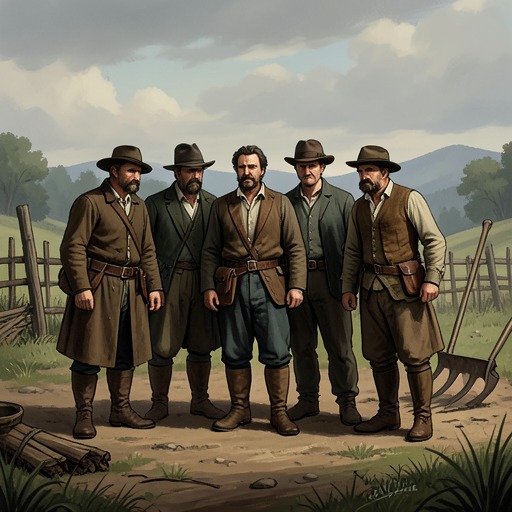
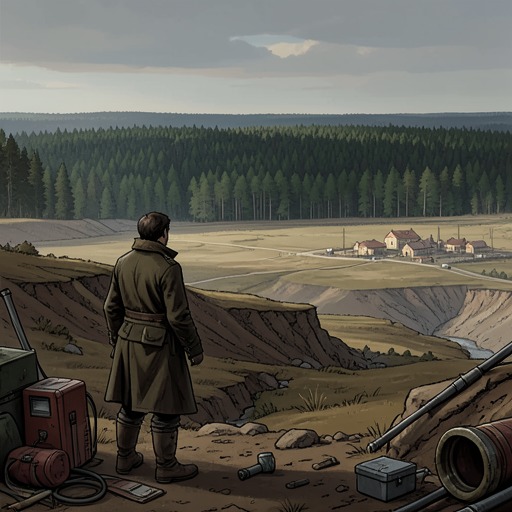
In the early 1820s, Charles led an expedition into the high country in search of more grazing land. His party included his youngest son, Neville, and five other men; at home he left his mother, Evelyn, his wife, Florence, and his daughter-in-law, Eleanor, with hired help. The Edwards family’s red-brick homestead, cleared land, hedges, and manicured lawn mark their wealth and settled claim to the country, while the Ngarigo have ancient connections to the land.
The newcomers relied on the Ngarigo to learn the high country. King Jimmy, the Ngarigo elder, showed Charles and his party tracks that an untrained eye could not see. Charles’s gift-giving, agreeable manner won the elder’s interest, although the Ngarigo viewed the white visitors as unfamiliar with the land’s ancient knowledge. The exchange was unequal in its later consequences: the settlers acquired practical knowledge of the country while their presence contributed to the displacement of its original inhabitants.
Violence and Hidden Paternity
During the expedition, white men assaulted Ngarigo women. Charles was among the perpetrators: he took a young woman by force, not knowing that she was the youngest promised wife of King Jimmy. She became pregnant and, after giving birth to a daughter with fair skin and fine features, left the newborn beneath her birthing tree overnight. The baby survived and was named Waraganj after the snow-gum under which she was born.
Waraganj’s birth exposed a conflict within her community over how the child might be received, but it did not erase the circumstances of her conception. Charles’s act remains concealed from the child and from the public account of his standing as a settler patriarch. Its consequences return years later when Waraganj appears at the Edwards property under the name Black Mary.
Recognition at the Edwards Homestead
After an absence of about eight months, Charles returned from a drove to find Black Mary working on the property. Florence and Eleanor described her as a hardworking and welcome presence, explaining that she had arrived distressed and that they had taught her to read and write. Charles initially paid little attention to her. Evelyn then drew him aside and made him look again.
He recognized a resemblance between Black Mary and his younger daughter, Bertha, and recalled the young Ngarigo woman he had assaulted on the expedition. Black Mary was the right age to be his daughter. The resemblance transformed her from a servant welcomed by the women of the household into evidence of his own past. Evelyn had noticed the likeness too and had kept the girl at the property until Charles returned, intending to confront him. Charles understood that Black Mary could be his child, but the evidence establishes recognition and suspicion rather than a public acknowledgment or any subsequent act of responsibility.
Settlement, Authority, and Consequences
Charles’s influence reaches beyond his homestead. He regularly attended district meetings and often led their discussions. He proposed that Cresthill, then an outpost, be marked for possible development, arguing that a town would benefit from the stock route and the arrival of more farmers and settlers. He also offered to help finance the town, while insisting that Aboriginal people needed to be managed. The meeting reached a consensus, and its decision was applied quickly to the alpine clans.
That civic role is inseparable from the colonial policy described in the novel: white settlers took land, erected fences, drove Aboriginal people from their homelands, and restricted their seasonal movement. Authorities treated dispersal and even shooting Aboriginal people on sight as permissible. Charles’s proposal for town development belongs to this same process: settlement is presented as progress for newcomers, while Indigenous presence is cast as an obstacle to be controlled.
The consequences of Charles’s private history also reach into a later generation. When Miss Shirley calls Molly Johnson’s children octaroons and asks Judge Eisenmangher to intervene, the judge authorizes their removal. The claim that Black Mary was Charles’s daughter resurfaces as a means of racial classification, while Molly recognizes that such labels can place her children at risk. She burns the signed order and leaves with them. The novel thus connects Charles’s concealed paternity to a system that turns mixed heritage into grounds for separating children from their mother.
Narrative Significance
Charles is defined by the contrast between the respectability attached to his public position and the violence that his family’s standing conceals. He is a founding settler, a landholder, and a promoter of town development; he is also the man whose assault produced Waraganj, whose resemblance to his legitimate daughter forces an unwelcome recognition. The narrative does not show him making amends or openly accepting Black Mary as his daughter.
His story binds together land acquisition, sexual violence, racial hierarchy, and the later machinery of child removal. The novel’s author’s note describes its fictional world as drawing on family history, Australian history, research, and oral stories from elders; within that world, Charles’s legacy shows how an individual act of violence can persist through kinship and classification, even when the perpetrator’s public reputation remains that of a respected founder.